01
Satire as a weapon against standardization
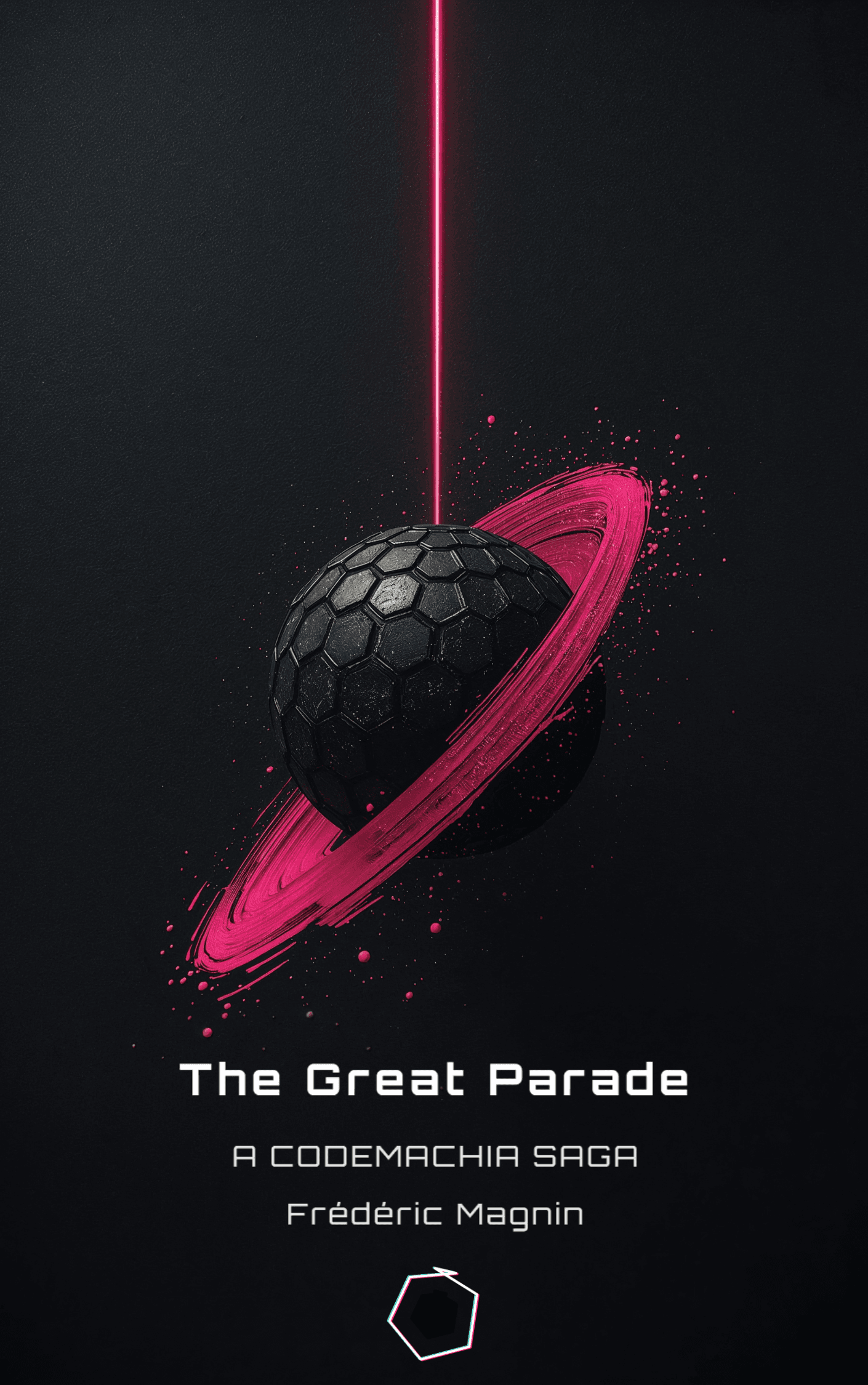
2192. Humanity has survived its own genius.
In the post-Judgment universe of Codemachia, during Cycle VII, where SΛLΛDIN seeks his identity and ZUMBI.NOVA bears collective memories, MANA survives differently: he mimics.
An ocean orphan in the Wastelands of Manila-Drift, Mana cleans illegal arenas, sorts wet confetti, and copies the voices of patrons to survive. He doesn't know what he likes, only what he copies.
Until the day one gesture changes everything.
Foundational gesture. Signature.
In Kyoto-Ame — a capital muzzled under a Chromatic Censorship Dome — colors are filtered, music confiscated, crayons seized from children. In a world where art is a weapon and laughter a crime, what can a boy who is only a mask do?
Every gag has a price. Every joke wounds. Every laugh leaves a trace.
The Great Parade is the third volume in a philosophical science fiction saga where satire becomes a weapon and laughter, a wound. A burlesque tale where every transformation is a cost and every victory, a humiliation.
Satire as a weapon against standardization
Creative anarchy against bureaucratic order
Laughter that costs and jokes that wound
Muzzled color and confiscated art
The conflict between creativity and conformity
The price of joyful resistance
Each book is an exploration of the great questions of our time, through the prism of a futuristic and mythological universe.
In a world where machines provide for our needs, what becomes of our humanity?